


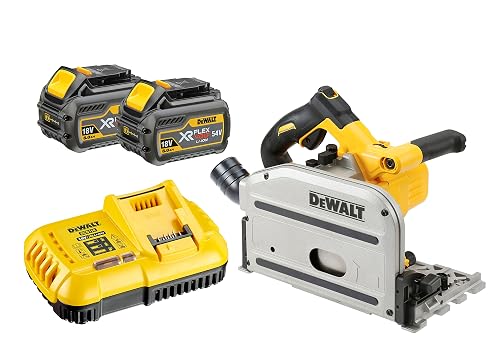
DEWALT XR Flex Volt
Best for Clean, straight, splinter-free cuts in sheet goods, worktops and boards.
We compare the Dewalt DWS520KT-GB and the Makita SP6000J1 across every dimension that matters - our scores, the key specs, and how each performs on the things you will actually notice day to day.
| Dewalt DWS520KT-GB | Makita SP6000J1 | |
|---|---|---|
| Our score | 8.9/10 | 9.5/10 |
| Best for | Clean, straight, splinter-free cuts in sheet goods, worktops and boards | Clean, straight, splinter-free cuts in sheet goods, worktops and boards |
| Not ideal for | Quick freehand cuts or rough site work where a standard circular saw is handier | Quick freehand cuts or rough site work where a standard circular saw is handier |
| Brand | DeWalt | Makita |
Cut quality and capacity are the first things to stand out on a plunge and track saw kit, because they determine how clean the kerf finishes and how far the tool can be relied on across different work. For the DeWalt DWS520KT-GB, cut neatness is tied to blade choice and the condition of the workpiece. A better edge finish comes from clamping the material firmly, keeping the plunge aligned, and allowing the saw to reach full operating speed before feeding into the cut. Capacity is best assessed in practical terms: thicker stock can require a slower feed and careful support to help reduce vibration, and results can vary by material type.
Cut quality and capacity on a plunge saw are driven by how well the plunge guides the blade into the work, because the blade needs a clean start and stable alignment as it lowers into the material. With this plunge saw, achieving consistently clean entry depends on setting the base firmly, using the correct guide line, and plunging smoothly rather than forcing the cut. Clean entry helps reduce chipping, and a steady forward feed supports a straighter kerf. For thicker boards or denser materials, capacity is mainly limited by available blade depth and the operator's technique, while dull blades will reduce edge quality over time.
DeWalt's DWS520KT-GB uses cordless power, which affects where it can be used and how quickly it can be set up on a jobsite. Cordless operation helps with moving between rooms, across floors, and around ladders without trailing a cable, which can reduce trip hazards and make cutting in tighter spaces more practical. Cordless performance is also dependent on battery condition, so longer tasks may require planning to avoid interruptions during a cut. For extended working periods, having spare battery capacity and the ability to swap batteries quickly can be important.
Occasionally, power type becomes the deciding factor on a plunge saw, because it affects how freely the tool can move and how consistent the cut stays during long sessions. The Makita is a corded plunge saw for 110 V mains, so it offers steady, uninterrupted power, as long as an extension lead is available. A corded setup typically reduces downtime, since there is no battery charging cycle, but it can limit reach on larger floors. For long, repeat cuts, a corded motor can help maintain consistent cutting effort. Cordless models trade this stability for portability, but battery limits may interrupt workflow.
With a plunge saw, the guide rail matters as much as the blade because it controls straight cuts and repeatable spacing. Buyers should check whether the included rail or any mounting interface exists, and whether their existing rails match those interfaces. If parts do not align, setup time increases, and consistent rail use improves cut accuracy only when tolerances suit the material.
A rail system is what keeps a plunge saw running straight and controlled, particularly on long board runs where edges need to line up precisely. The plunge saw is a corded plunge saw, so it can be used consistently when matched with a suitable guide rail setup. Compatibility depends on the rail connection method, the alignment accuracy of the rail, and whether the saw's base is designed to lock onto that specific rail type. The provided details do not specify a particular rail standard, so fitment must be confirmed before purchase. A mismatch can introduce gaps or wandering cuts, so checking the fit on a short straight test cut along the intended guide rail helps verify alignment.
Good dust handling and practical controls largely shape how a plunge saw feels during real jobs, and the Dewalt DWS520KT-GB's build and handling details are limited in the information provided. The title indicates it is supplied with a TSTAK box, which helps with organising and transport. For dust extraction, no hose size, airflow, or extraction method is stated, so extraction performance cannot be confirmed. In use, a common approach is to connect to an appropriate dust system, check the shroud seals, then run a short test cut before tackling full cuts.
Because the Makita is a corded plunge saw, its build and dust handling directly affect cut quality and daily usability, particularly when working with a guide rail. Its solid, plunge-capable design supports a stable cutting motion, which helps the blade track along the rail line. The mains lead does restrict movement, so the working position and cable routing need to be planned around the cut path. Dust extraction performance depends on the connection quality between the hose and the extraction port, as well as how the dust bag or vacuum is positioned during rail-guided cuts. If extraction airflow drops, dust control and visibility during cutting worsen, and cleanup becomes more work.
Pair the saw with a compatible dust setup and carry out a short test cut first. This plunge saw is suited to tradespeople and fitters who need repeatable plunge entries in wood, sheet materials and general joinery work. It is also aimed at users who want a dedicated plunge workflow rather than careful edge starts, with transport convenience helped by the included TSTAK box. Buyers looking for a one-tool solution across every job may find limitations, because key performance specifications are not stated.
This plunge saw is best suited to users who want a corded tool and plan to cut using a guide rail or a stable working setup. The plunge saw is built for plunge-style cutting and is mains powered, so it fits cleanly into workshops and other places with reliable power access. Control comes from plunging the blade into the workpiece, then continuing along a marked line with added support. It is less ideal for regular outdoor work where extension leads are inconvenient, or for anyone prioritising maximum portability. Beginners may need a little practice to achieve clean starts and accurate plunge positioning.
Our pick is the Makita SP6000J1 (our score 9.5/10) - A precise plunge saw (corded) for accurate rail-guided cutting. The Dewalt DWS520KT-GB is still worth it if it is cheaper when you check, or if it better matches your specific needs.
Best for Clean, straight, splinter-free cuts in sheet goods, worktops and boards.
Best for Clean, straight, splinter-free cuts in sheet goods, worktops and boards.